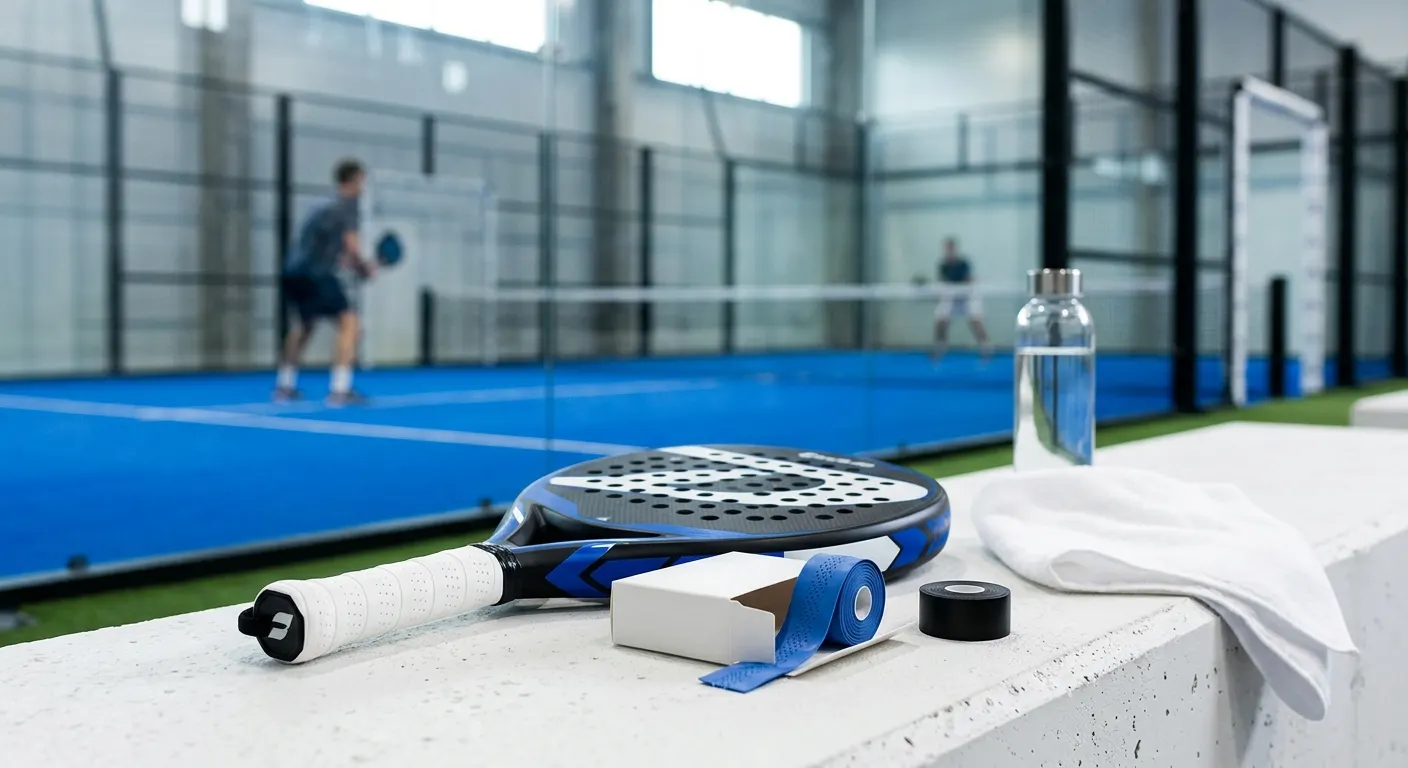
An overgrip is the cheapest performance upgrade in padel and the only piece of equipment in constant contact with your hand throughout every session. Most players stick with whatever overgrip ships on the racket, which is usually a basic replacement grip, and never revisit the choice. That is a mistake. A worn or wrong-style overgrip increases the grip pressure your hand has to apply to control the racket, which directly increases the stress on the forearm tendons that cause padel elbow. The right overgrip, changed at the right intervals, is a real injury-prevention measure, not just a comfort choice. Start with the Bullpadel GB-1201 Overgrip (3-Pack) as your baseline and adjust from there.
Quick answer
The Bullpadel GB-1201 is the best all-round padel overgrip: its dry-feel micro-perforated surface wicks sweat without getting slick, and it is the most widely used overgrip on the World Padel Tour. Players who prefer a tacky surface should use the Head Padel Pro Overgrip instead. Change overgrips every two to four weeks, or sooner once the grip feels slick.
This guide contains affiliate links. CourtKin may earn a commission at no cost to you.
Tacky versus dry feel: which camp are you in?
Every overgrip falls into one of two feel profiles, and the right choice depends on your hand temperature and the climate you play in more than anything else.
Dry-feel overgrips have a slightly textile surface. They wick sweat aggressively, and they stay grippy even when saturated. This is the preferred style for players with warm, sweaty hands and for anyone playing in hot or humid conditions. The Bullpadel GB-1201 Overgrip (3-Pack) is the dry-feel standard: its micro-perforated surface improves airflow and wicks moisture faster than flat-surface alternatives. It is the most used overgrip on the World Padel Tour for exactly this reason.
Tacky-feel overgrips have a slightly sticky surface that grips firmly with very light hand pressure, reducing the need to squeeze the racket. This is comfortable in cool, dry conditions and at the start of a session in moderate conditions. The Head Padel Pro Overgrip (3-Pack) is the leading tacky option: confident grip, widely available, and priced competitively.
The problem with tacky grips in heat or humidity is that once the surface saturates with sweat it can go slick quickly. If you play outdoors in summer, dry-feel is the reliable choice. If you play indoors in an air-conditioned club in a cool climate, tacky is a reasonable preference.
The Nox Luxury Overgrip (3-Pack) tries to bridge both camps with a dual-feel design that starts tacky when dry and activates drier as sweat fills the micro-perforations. It works well for players whose hands change state across a long session but can feel inconsistent across different humidity levels.

Bullpadel GB-1201 Overgrip (3-Pack)
The most-used overgrip on the World Padel Tour: a micro-perforated dry-feel surface that wicks sweat reliably without getting slick, trusted by professionals who play in heat and humidity.

Head Padel Pro Overgrip (3-Pack)
The leading tacky-feel overgrip for padel, offering a slightly sticky surface that grips firmly without squeezing hard, suited to players who prefer the tacky-feel camp.
Nox Luxury Overgrip (3-Pack)
Nox's premium overgrip with a dual-feel design that starts slightly tacky and transitions to a dry-feel as sweat activates the micro-perforations, aiming to serve both grip camps.
How thick should your overgrip be?
Thickness affects both feel and racket balance. A thinner overgrip adds almost no bulk to the handle, keeps the racket's factory balance unchanged, and suits players who like to feel the handle pallet directly under the grip.
A thicker overgrip adds slight cushioning and shifts the balance very slightly toward the grip end, making the racket feel marginally more head-light. For most players this is a negligible effect, but players who are very particular about weight distribution and balance should stick to thin wraps.
Most padel overgrips are in the 0.6mm to 0.8mm range. Stacking two overgrips is a legitimate choice for players who want a thicker handle or extra cushioning, but be aware that the combined thickness shifts balance more noticeably than a single wrap.
A correct grip size matters too. There should be enough space for your little finger between your fingertips and the heel of your hand when you close the grip. If the handle feels too thin, add an overgrip; if it feels too thick, use the thinnest overgrip available.
How often should you change overgrips?
Every two to four weeks if you play two to three times a week, or sooner if the grip feels slick, shreds at the edges, or loses its original feel. A worn overgrip is not just uncomfortable: it forces you to grip the racket harder to maintain control, which directly loads the forearm flexors and increases the risk of epicondyle problems over time.
The practical test is simple: pick up the racket with a dry hand and give it a slight twist. If the grip feels immediately slippery rather than secure, it is overdue for a change. Many experienced players change overgrips after every session in hot conditions.
Buying multi-packs reduces the per-unit cost significantly. The Wilson Pro Padel Overgrip (12-Pack) brings the per-grip cost to roughly $2 to $2.70 each, which makes frequent changes economical even for casual players.

Wilson Pro Padel Overgrip (12-Pack)
Wilson's padel overgrip sold in a 12-pack for players who change grips frequently and want a reliable tacky-to-neutral feel at a low per-unit cost.
How to wrap an overgrip correctly
Remove the racket's factory overgrip if one is installed, but leave the base grip underneath it intact. The base grip sets the handle size and shape; the overgrip goes on top. Removing the base grip before wrapping leaves the bare pallet edge exposed, which is uncomfortable and eventually damages the overgrip.
Start at the base of the handle with the adhesive end of the overgrip. Wrap at a 45-degree angle with a slight overlap of around 2mm to 3mm per turn, pulling gently to keep tension even. Too little tension leaves air pockets; too much thins the grip unevenly. Finish near the top of the handle and secure with the finishing tape that comes in the pack.
The whole process takes about 90 seconds once you have done it a few times. Watch one wrap video the first time and the technique becomes intuitive immediately.
Overgrips and elbow health
A fresh overgrip with the right feel for your hand type is a genuine elbow-health measure, not just a performance choice. When a grip goes slick, you grip harder. Gripping harder during wrist-snap shots like the smash and vibora loads the lateral epicondyle tendons more than any other variable you control.
If you are already managing mild elbow symptoms, prioritise a thick, cushioning overgrip and a softer-core racket alongside the Padel Elbow Counterforce Brace and Sleeve . Those three changes together reduce the shock and loading that cause the problem. Do not wait for pain to develop: change overgrips frequently, grip no harder than necessary, and warm up the wrist and forearm before hitting hard.
Bullpadel GB-1201 Overgrip (3-Pack)
The most-used overgrip on the World Padel Tour: a micro-perforated dry-feel surface that wicks sweat reliably without getting slick, trusted by professionals who play in heat and humidity.
Head Padel Pro Overgrip (3-Pack)
The leading tacky-feel overgrip for padel, offering a slightly sticky surface that grips firmly without squeezing hard, suited to players who prefer the tacky-feel camp.
Nox Luxury Overgrip (3-Pack)
Nox's premium overgrip with a dual-feel design that starts slightly tacky and transitions to a dry-feel as sweat activates the micro-perforations, aiming to serve both grip camps.
Wilson Pro Padel Overgrip (12-Pack)
Wilson's padel overgrip sold in a 12-pack for players who change grips frequently and want a reliable tacky-to-neutral feel at a low per-unit cost.

Padel Elbow Counterforce Brace and Sleeve
A lateral epicondyle counterforce brace with an integrated compression sleeve that reduces tendon load during the wrist-snap shots that commonly cause padel elbow in high-volume players.
FAQ
Frequently asked questions
What is the most popular overgrip on the World Padel Tour?+
The Bullpadel GB-1201 is the most widely used overgrip at the professional level. Its micro-perforated dry-feel surface wicks sweat reliably without going slick in the heat and humidity of professional matches.
Can I use a tennis overgrip for padel?+
Technically yes, since the handle dimensions are similar, but padel-specific overgrips are engineered for the wrist-snap technique padel requires and for the longer, hotter sessions that outdoor padel involves. Stick to padel-labelled options if you can.
Does overgrip thickness affect swing speed?+
A very small amount. Adding overgrip shifts the balance slightly toward the grip end, which makes the racket feel marginally head-lighter and can make it feel faster to swing. A thicker handle may also allow you to grip slightly less firmly, which relaxes the forearm and can contribute to a more fluid stroke.
Should I wrap the overgrip over the base grip or remove it first?+
Always wrap over the base grip, not instead of it. The base grip sets the handle size and protects the bare pallet. Removing it leaves the sharp pallet edges exposed and makes the handle too thin, which changes the feel and can cause hand discomfort.